Medical Disclaimer: The information provided in this article is for educational purposes only and does not constitute professional medical advice, diagnosis, or treatment. Always seek the advice of your dermatologist or a qualified hair care professional with any questions you may have regarding a scalp condition or hair health.
Table of Contents
- The Evolution of Texture: Understanding Your Curls in 2026
- The Science of the Curl: Why Your Hair Behaves the Way It Does
- The Classification System: From Type 2 Waves to Type 4 Coils
- Type 2: Navigating the World of Wavy Hair
- Type 3: Mastering the Art of Defined Curls
- Type 4: Celebrating the Beauty of Coily and Kinky Textures
- Porosity and Elasticity: The Hidden Factors of Hair Health
- Common Scalp Conditions and Treatment Options for Curly Hair
- 2026 Innovations: Biotech and Personalized Curly Hair Care
- Prevention and Long-Term Maintenance Strategies
- Frequently Asked Questions (FAQ)
- Key Takeaways
- Conclusion
The Evolution of Texture: Understanding Your Curls in 2026
Welcome to the era of the “Natural Renaissance.” As we move through 2026, the global perspective on hair has shifted profoundly. For decades, the beauty industry pushed a standardized image of sleek, straight hair. Today, you are living in a world where individuality and natural texture are not just accepted—they are celebrated as the gold standard of personal expression.
Understanding your curly hair type is no longer just about choosing the right shampoo; it is about understanding your biological blueprint. Research in 2025 and 2026 has shown that the shape of your hair follicle and the distribution of keratin proteins within the hair shaft are as unique as a fingerprint. When you embrace your natural pattern, you are participating in a movement of self-acceptance that has reshaped the cosmetic industry.
For many of you, the journey to loving your curls has been fraught with trial and error. You may have spent years fighting frizz, battling humidity, or using chemical relaxers that compromised your hair’s integrity. In this comprehensive guide, we will provide you with the medical insights, practical treatments, and preventative measures necessary to ensure your curls remain vibrant and healthy. Whether you have loose waves or tight, intricate coils, this guide is designed to navigate the complexities of your specific hair needs using the latest dermatological findings and styling innovations of 2026.
We believe that knowledge is the foundation of confidence. By the time you finish reading this, you will have a professional-grade understanding of your hair’s anatomy, a personalized approach to maintenance, and an awareness of the cutting-edge treatments currently available in the United States.
The Science of the Curl: Why Your Hair Behaves the Way It Does
To truly care for your hair, you must first understand the “why” behind the “what.” In 2026, trichologists (hair and scalp specialists) have reached a consensus on the mechanical and biological drivers of curl formation.
The Follicle Shape
The primary determinant of your hair type is the shape of your follicle—the tunnel-like segment of the epidermis that houses the hair root. If your follicle is perfectly round, your hair will grow straight. If the follicle is oval or asymmetrical, the hair emerges at an angle, resulting in a curl. The more asymmetrical the follicle, the tighter your curl pattern will be.
Disulfide Bonds and Protein Distribution
Inside each hair strand, your hair is held together by chemical bonds, specifically disulfide bonds. In curly hair, these bonds are distributed unevenly. Furthermore, the distribution of two types of cells—orthocortex and paracortex—determines how the hair twists. When you apply heat or chemical treatments, you are temporarily or permanently altering these bonds, which is why your hair “loses” its curl over time if damaged.
The Sebum Challenge
One of the most significant medical realities of having curly hair is the distribution of sebum (natural scalp oil). In straight hair, sebum travels easily from the scalp down the hair shaft, providing natural lubrication. In your curly hair, the twists and turns act as “speed bumps,” preventing the oil from reaching the ends. This is why you likely find that your scalp is oily while your ends remain chronically dry.
The Classification System: From Type 2 Waves to Type 4 Coils
The most widely recognized method for identifying hair texture is the numerical system ranging from 1 to 4, with sub-classifications of A, B, and C. While Type 1 is straight, Types 2 through 4 encompass the vast spectrum of curls.
| Hair Type Category | Primary Characteristic | Visual Description |
|---|---|---|
| Type 2 (Wavy) | S-shaped waves | Loose, beachy, or defined waves that lay closer to the head. |
| Type 3 (Curly) | Spirals and ringlets | Defined curls ranging from large loops to tight corkscrews. |
| Type 4 (Coily) | Zig-zags or tight coils | Densely packed curls with significant shrinkage and high volume. |
In 2026, we also look at “multi-textural” profiles. It is very common for you to have Type 3C curls at the nape of your neck and Type 4A coils at the crown. Recognizing this diversity on your own head is the first step toward effective management.
Type 2: Navigating the World of Wavy Hair
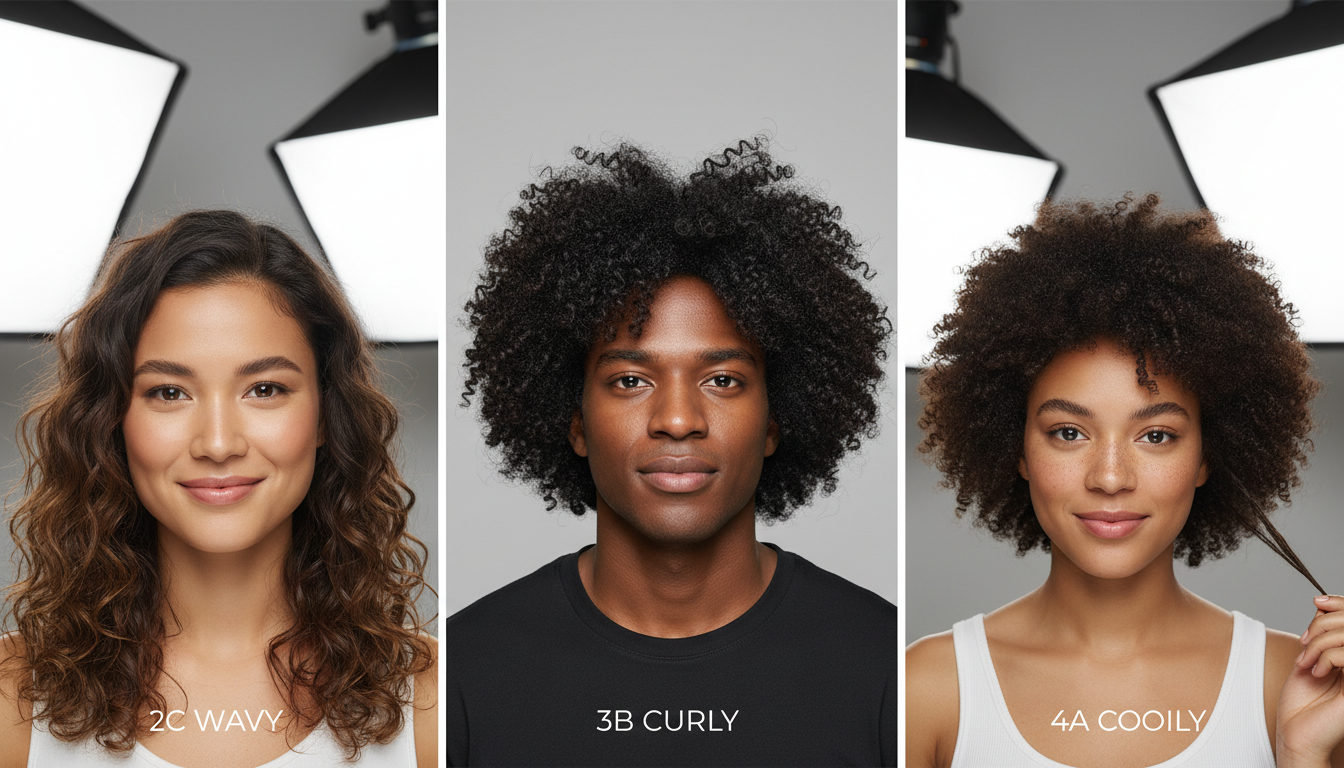
Type 2 hair is often the most misunderstood. You might spend years thinking your hair is just “frizzy straight hair” before realizing you actually have a beautiful wave pattern waiting to be unlocked.
Type 2A: The Subtle Wave
Your hair is fine and thin with a very loose “S” pattern. It lacks volume at the root and can easily be weighed down by heavy products. To care for this, we recommend that you use lightweight mousses rather than heavy creams.
Type 2B: The Defined Wave
You have a more prominent “S” shape, usually starting from the mid-length to the ends. You are prone to frizz, especially in humid climates like the American Southeast. 2026 stylists suggest using a “sea salt alternative” that provides grit without the drying effects of sodium.
Type 2C: The Borderline Curl
Your waves are thick, coarse, and start right at the root. This type is very prone to frizz and can easily lose its definition if brushed dry. We recommend that you utilize “plopping” techniques—wrapping your hair in a microfiber towel—to preserve the wave integrity.
Expert Quote: “The biggest mistake Type 2 individuals make is over-washing. Even with waves, your hair needs those natural oils to prevent the cuticle from lifting and creating frizz.” — Dr. Elena Vance, Senior Trichologist at the New York Hair Institute.
Type 3: Mastering the Art of Defined Curls
Type 3 hair represents the classic “curly” look. These are distinct spirals that, when healthy, have plenty of bounce and shine.
Type 3A: The Large Loop
Your curls are about the width of a piece of sidewalk chalk. They are shiny and well-defined but can be easily blown out by wind or touched too much. You should focus on “scrunching” in a light-hold gel while your hair is soaking wet.
Type 3B: The Springy Ringlet
These curls have the circumference of a Sharpie marker. They have more volume and a tighter bounce than 3A. Moisture is your best friend. In 2026, we see a rise in “water-cycling,” a technique where you hydrate the hair multiple times during the styling process to lock in moisture at every level.
Type 3C: The Corkscrew
Your curls are tight and highly textured, often the size of a drinking straw or a pencil. They are densely packed together, giving you immense natural volume. Because the curls are so tight, you are more susceptible to dryness. We recommend a “LOC” (Leave-in, Oil, Cream) method to ensure the hair shaft is fully sealed.
Treatment Options for Type 3
- Deep Conditioning: At least once a week to maintain elasticity.
- Steaming: Using a hair steamer helps open the cuticle for better product absorption.
- Detangling: Only detangle when the hair is saturated with conditioner using a wide-tooth comb or your fingers.
- Low Porosity: Your cuticles are tightly closed. Water beads up on the hair. You need heat (like a warm towel) to open the cuticle to let moisture in.
- Medium Porosity: The “ideal” state. Your hair absorbs and retains moisture easily.
- High Porosity: Your cuticles are wide open (often due to damage). Hair absorbs water quickly but loses it just as fast. You need heavy butters and oils to “plug” the holes in the cuticle.
- Treatment: We recommend that you use a medicated shampoo containing ketoconazole or zinc pyrithione once every two weeks, focusing strictly on the scalp to avoid drying out your curls.
- Treatment: Avoid tight hairstyles that pull on the scalp (traction). Use tea tree oil or prescribed topical antibiotics if the condition persists.
- Treatment: This is often caused by mechanical stress. The best treatment is “prevention through hydration” and minimizing the use of high-heat tools.
- Recommendation: You should use a 100% silk or high-quality satin bonnet or pillowcase. Additionally, “pineappling”—gathering your curls loosely at the top of your head—prevents you from crushing them while you sleep.
- Omega-3 Fatty Acids: Found in flaxseeds and walnuts, these lubricate the hair from the inside out.
- Biotin and Zinc: Essential for keratin production.
- Hydration: If you are dehydrated, your hair follicles will be the first to suffer. Aim for at least 80-100 ounces of water daily.
Type 4: Celebrating the Beauty of Coily and Kinky Textures
Type 4 hair is the most delicate of all hair types. Despite its appearance of being “tough” or “thick,” the tight turns in the hair shaft create points of weakness where the hair can easily snap.
Type 4A: The Defined Coil
You have a visible “S” or “Z” pattern that is tightly coiled. Your coils are about the size of a crochet needle. Your hair has a high degree of shrinkage—meaning it looks much shorter than it actually is when dry.
Type 4B: The Zig-Zag
Your hair doesn’t always “curl” in a circle; instead, it bends in sharp angles like the letter “Z.” This creates a fluffy, voluminous look. Because the angles are so sharp, sebum almost never reaches the ends, making intense hydration a medical necessity for hair retention.
Type 4C: The Intricate Texture
Type 4C is similar to 4B but even more densely packed. There may be no visible curl pattern to the naked eye unless the hair is soaking wet and styled with specific techniques. This is the most fragile hair type. In 2026, the trend for 4C hair focuses on “protective styling” that allows the scalp to breathe while keeping the ends tucked away.
Statistics 2026: A recent survey by the American Academy of Dermatology found that 68% of individuals with Type 4 hair who switched to sulfate-free, biotech-enhanced cleansers reported a 40% reduction in breakage within six months.
Porosity and Elasticity: The Hidden Factors of Hair Health
While your curl type tells you what your hair looks like, porosity and elasticity tell you how your hair functions.
Porosity: The Gatekeeper
Porosity is your hair’s ability to absorb and retain moisture. It is determined by the state of your cuticle (the outer layer of the hair).
Elasticity: The Strength Test
Elasticity is the measure of how much your hair can stretch and return to its original shape without breaking. If you pull a curl and it snaps immediately, you have low elasticity, which usually indicates a protein deficiency. If it stretches and doesn’t bounce back, you likely have “moisture overload” and need a protein treatment.
| Factor | High State Characteristics | Low State Characteristics |
|---|---|---|
| Porosity | Frizzy, dries instantly, lacks shine. | Takes forever to get wet, product buildup. |
| Elasticity | Bouncy, resilient, handles styling. | Brittle, snaps easily, limp. |
Common Scalp Conditions and Treatment Options for Curly Hair
Healthy hair starts with a healthy scalp. Because curly hair involves less frequent washing, the scalp can become a breeding ground for various conditions.
Seborrheic Dermatitis
This is a common medical condition characterized by red, itchy, and scaly skin. In curly-haired individuals, the buildup of oils and products can exacerbate this.
Folliculitis
This is the inflammation of the hair follicles, often caused by bacterial or fungal infections. It can appear as small red bumps or white-headed pimples around the hair follicles.
Trichorrhexis Nodosa
This is a fancy medical term for “frayed spots” or “weak points” on the hair shaft. It leads to easy breakage.
2026 Treatment Spotlight: Scalp Microbiome Balancing
In 2026, we have moved beyond simple “dandruff shampoos.” Modern treatments now include probiotic scalp serums that balance the natural bacteria on your head, reducing inflammation and promoting faster hair growth.
2026 Innovations: Biotech and Personalized Curly Hair Care
The year 2026 has brought revolutionary changes to how you care for your curls. We have moved away from “one size fits all” bottles toward scientifically engineered solutions.
AI-Driven Regimens
You can now use smartphone apps that utilize high-resolution cameras to analyze your hair’s diameter, porosity, and curl pattern. These apps then formulate a custom shampoo and conditioner set that is shipped to your door. This precision eliminates the “trial and error” phase that has historically frustrated many curly-haired people.
Synthetic Spider Silk Proteins
One of the biggest breakthroughs in 2026 is the use of lab-grown silk proteins. Unlike traditional proteins that can make hair “crunchy,” these synthetic proteins mimic the elasticity of spider silk. They wrap around your curls, providing a microscopic “exoskeleton” that protects against humidity without weighing the hair down.
Smart Heat Tools
If you must use heat, the tools of 2026 are lightyears ahead. New “infrared ionic” diffusers measure the moisture levels of your hair 100 times per second. If the tool senses the hair is becoming too dry, it automatically lowers the temperature to prevent heat damage.
Prevention and Long-Term Maintenance Strategies
Maintaining curly hair is a marathon, not a sprint. To keep your curls in peak condition, you must adopt a preventative mindset.
The Nighttime Routine
Friction is the enemy of the curl. When you sleep on cotton pillowcases, the fibers “grab” your hair, causing tangles and moisture loss.
Nutritional Support
Your hair is an extension of your internal health. For optimal curl definition and strength, your diet should be rich in:
Trimming for Health
While it may seem counterintuitive to cut your hair when you want it to grow, “dusting” (taking off less than a quarter-inch) every 8-12 weeks is vital. This prevents split ends from traveling up the hair shaft and causing widespread damage.
Frequently Asked Questions (FAQ)
Q: How often should I actually wash my curly hair?
A: In 2026, the consensus is that “less is more,” but you must still maintain scalp hygiene. For Type 2, twice a week is usually sufficient. For Types 3 and 4, once a week or even once every ten days—with “co-washing” (washing with conditioner) in between—is recommended.
Q: Can I change my hair type?
A: Your natural hair type is genetically determined by your follicle shape. While you can change the appearance with heat or chemicals, the hair growing from your scalp will always be your biological type. However, improving your hair’s health can make your curls appear tighter and more defined.
Q: Why does my hair look great when wet but frizzy when dry?
A: This is usually a sign of high porosity or a lack of “hold” products. When wet, the water weight holds the curls together. As the water evaporates, the hair strands separate and seek moisture from the air, causing frizz. You need to apply a sealer (like an oil or anti-humidity gel) while the hair is still wet.
Q: Are sulfates really that bad?
A: For curly hair, yes. Sulfates are harsh detergents designed to strip away grease. Because curly hair is naturally dry, sulfates strip away the essential oils your hair needs to remain elastic and shiny. Always look for “sulfate-free” on the label.
Q: What is “shrinkage,” and is it a bad thing?
A: Shrinkage is when your curls pull up toward the scalp as they dry. While it can be frustrating if you want length, shrinkage is actually a sign of healthy, high-elasticity hair. It means your “springs” are working!
Q: How do I handle “the transition” from chemically straightened hair to natural?
A: This is a test of patience. You have two choices: “The Big Chop” (cutting off all processed hair) or “long-term transitioning” (using protective styles like braids or wigs while your natural hair grows out). We recommend regular protein treatments during this time, as the point where the two textures meet is very fragile.
Key Takeaways
* Identify Early: Knowing if you are a 2A or a 4C changes everything from the products you buy to the way you sleep.
* Prioritize the Scalp: You cannot grow beautiful curls from an inflamed or dirty scalp. Treat your scalp like skin, not just a hair-growing surface.
* Moisture is King: Curly hair is biologically predisposed to dryness. Use the LOC method (Leave-in, Oil, Cream) to lock in hydration.
* Embrace Technology: Don’t be afraid of the 2026 biotech advancements. Synthetic proteins and AI-driven routines can save you hundreds of dollars in the long run.
* Gentle Handling: Use microfiber towels, silk pillowcases, and wide-tooth combs. Your curls are delicate structures; treat them as such.
Conclusion
As we look toward the remainder of 2026, the “Standard of Beauty” has officially been decentralized. You no longer have to conform to a style that requires you to damage your hair’s natural structure. Whether you possess the soft, beachy waves of Type 2, the vibrant, springy ringlets of Type 3, or the powerful, intricate architecture of Type 4, your hair is a testament to your heritage and your health.
The journey to mastering your curly hair type is one of education and intuition. By understanding the medical needs of your scalp and the structural requirements of your hair shaft, you empower yourself to make better choices. You now know that frizz is just a cry for moisture, that shrinkage is a sign of strength, and that your curls are as unique as you are.
We encourage you to take the information provided in this guide and apply it with patience. Natural hair care is an evolving science, and as new treatments emerge in the coming years, always remember that the foundation of great hair is consistent, gentle maintenance. Wear your curls with pride—they are your natural crown, and you now have the tools to make them shine brighter than ever before.